RAPID CITY, S.D. – A South Dakota man has been arrested on felony and misdemeanor charges, including for allegedly assaulting law enforcement during the Jan. 6, 2021, breach of the U.S. Capitol. His actions and the actions of others disrupted a joint session of the U.S. Congress convened to ascertain and count the electoral votes related to the 2020 presidential election.
37 year old William George Knight of Rapid City is charged in a criminal complaint filed in the District of Columbia with obstruction of law enforcement during a civil disorder and assaulting, resisting or impeding certain officers, both felony offenses.
In addition to the felonies, Knight is charged with five misdemeanor offenses, including entering and remaining in a restricted building or grounds, disorderly and disruptive conduct in a restricted building or grounds, engaging in physical violence in a restricted building or grounds, disorderly conduct in a Capitol building, act of physical violence in the Capitol grounds or buildings.
The FBI arrested Knight on May 26th in Rapid City. He was expected to make his initial appearance Wednesday in the District of South Dakota.
According to court documents, on Jan. 6, 2021, Knight attended the “Stop the Steal” rally in Washington, D.C., and witnessed the United States Park Police take an individual into custody. A crowd of others, including Knight, allegedly pursued the USPP to a screening facility, a glass structure, and Knight aggressively approached the glass wall four times over approximately seven minutes, each time pushing himself off the wall and gesturing toward police. Knight then put his middle fingers up to the glass and pointed menacingly at the police inside the Screening Center.
Knight later made his way toward the Capitol and entered the Capitol grounds via the Maryland Avenue walkway. Knight and others were allegedly among the first rioters to breach the restricted perimeter and arrive at the West Plaza at approximately 12:57 p.m. A short while later, Metropolitan Police Department Officers arrived to reinforce Capitol Police and set up a barrier using bike racks on the West Plaza. It is alleged that Knight grabbed one of the bike rack barriers and fell backward because he had pulled on the barrier so forcefully.
At about 1:14 p.m., Knight allegedly attempted to pull a second bike rack barrier away from a different nearby police line. After initially grabbing the second bike rack, Knight retreated before charging toward the police line and diving to grab the barrier. Court documents say that MPD officers had to deploy chemical spray to stop Knight. Knight then jeered at the police line for several minutes, pointed at them aggressively multiple times, and yelled at the police, “We ain’t leaving! We ain’t going nowhere!” and “Here are the b—. Here are the b—.”
Court documents allege that at about 1:40 p.m., Knight and a large group of other rioters pushed a giant metal-framed sign toward the police line. After ramming the sign at police, Knight allegedly shoved an MPD officer and again grabbed a bike rack barrier and pulled it into the crowd, depriving the police of its use. Knight remained at the vanguard of rioters confronting officers, chanting, “Stop the steal! Stop the steal!” with other rioters.
Later, at approximately 2:08 p.m., Knight is alleged to have been part of a group of rioters that pushed together against the police line on the Lower West Plaza. The police line collapsed at approximately 2:30 p.m., and Knight and other rioters made their way up one level to the Lower West Terrace. Knight remained on the Lower West Terrace for at least two hours.
This case is being prosecuted by the U.S. Attorney’s Office for the District of Columbia and the Department of Justice National Security Division’s Counterterrorism Section. Valuable assistance was provided by the U.S. Attorney’s Office for the District of South Dakota.
The case is being investigated by the FBI’s Minneapolis Division, Rapid City Resident Agency, and Washington Field Offices. Valuable assistance was provided by the U.S. Capitol Police and the Metropolitan Police Department.
In the 40 months since Jan. 6, 2021, more than 1,424 individuals have been charged in nearly all 50 states for crimes related to the breach of the U.S. Capitol, including more than 500 individuals charged with assaulting or impeding law enforcement, a felony. The investigation remains ongoing.
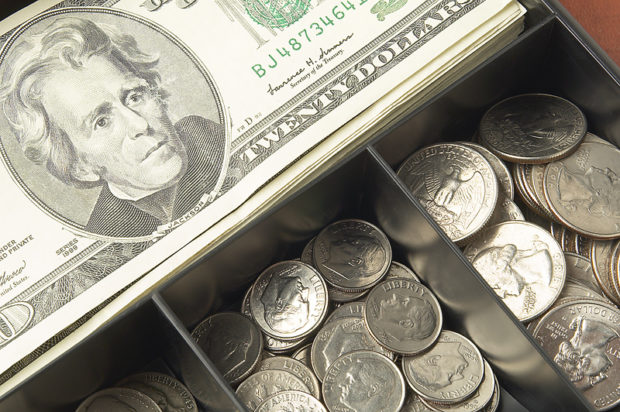
PIERRE, S.D. (Joshua Haiar/South Dakota Searchlight) – Despite a $32 million dip in sales tax revenue, South Dakota has collected about $115 million more in total revenue this year than it did the previous July through April.
That news was shared with the Governor’s Council of Economic Advisors Tuesday by state Bureau of Finance and Management economist Derek Johnson. The council includes economists and businesspeople from around the state who review and critique the department’s forecasting.
Tax collection metrics begin in July because a fiscal year in South Dakota runs from July 1 to June 30 the following year.
The state’s unclaimed property fund is the primary reason for the revenue uptick in the face of sales tax declines The state has banked approximately $62 million more this year in abandoned or forgotten money from bank accounts, stocks, life insurance payouts, uncashed checks and the contents of safe deposit boxes. The holder of the money or items, such as a bank, tries to find the owners. After three years of dormancy, the property reverts to the state. The property represents a perpetual liability to the state, however, as the state is obligated to pay the rightful owner at any point.
“Kind of an unpredictable revenue source that we have in South Dakota,” Johnson said.
It is difficult to say what caused the unclaimed property uptick, according to South Dakota Bankers Association President Karl Adam, who serves on the council.
“I’m not questioning the sustainability of it, but that is something that I know the state relies heavily on, and I don’t know if there would be an asterisk next to that for future years,” Adam said.
Adviser Derek Johnson agreed.
“As it pertains to unclaimed property, certainly there should be an asterisk by that number.”
Earnings from the state’s investments have jumped by $35 million this year, as well. This includes returns from assets the state holds, like bonds and stocks. The income might come as interest payments or dividends.
“Certainly was a big boost to the general fund,” Johnson said, referring to the state’s primary budget.
Contractor’s excise tax revenues are also up about $24 million, referring to the tax contractors pay based on earnings from construction and repair projects.
The $31.9 million decline in sales and use tax revenue was largely due to a reduction in the state sales tax rate from 4.5% to 4.2%. That happened in July 2023.
IOWA – Early voting is underway in Iowa ahead of next Tuesday’s primary election. This election gives voters the chance to decide which candidates will make it onto the November ballot.
Races on the ballot include statehouse races as well as congressional candidates in three of Iowa’s congressional districts.
If you’re not registered to vote, people with an Iowa driver’s license can register online or at the polls on election day. You can also change what political party you’re registered with when you go to vote too.
More information, ranging from where to go to vote, tracking absentee ballots, and more can be found at the website VoterReady.iowa.gov.
Absentee ballots must be received by the county auditor’s office by 8 p.m. on election night in order to be counted, so it is best to send that in as soon as possible.
One interesting item to watch in Iowa is the fact that Libertarians are holding their first primary in the state since 2018. That is due to the fact that they got more than 2% of the statewide vote in the last election. That’s the minimum requirement to appear as a political party on the ballot.
Political watchers will be interested to see if they continue to get that 2% voter turnout, because if they don’t they will drop back down to non-political party status.
DES MOINES, IA (Mark Moran / Iowa News Service) – Advocates for Iowa’s older population are calling on seniors to vote in Tuesday’s primary election and have identified their priorities for candidates seeking their support.
There are three ways to vote in Tuesday’s primary. Voters can choose to cast a ballot by mail, vote early in person at their county auditor’s office, or the old-fashioned way, by going to polling places and filling out a paper ballot on Election Day.
Brad Anderson, state director of AARP Iowa, said whatever method they choose, there is power in numbers for the state’s older voters.
“One thing we know for sure is that older voters will dominate the overall turnout,” Anderson pointed out. “During the last primary election in 2022, 77% were 50 or older.”
Anderson said because Iowa’s older voters turn out in high numbers at the polls, AARP is telling candidates exactly what is important to the state’s seniors and what it takes to win their support. He pointed out retirement and health care-related issues top the list.
Anderson added the group has laid out a list of priorities for the candidates, reminding them three of four voters in Tuesday’s primary will be 50 or older and their votes could decide the election.
“Older voters care deeply about the future of Social Security,” Anderson observed. “They also care about Medicare and making sure Medicare is intact. And then finally, they care deeply about lowering the cost of prescription drugs.”
Anderson stressed despite recent steps taken as part of the Inflation Reduction Act to reduce the prices of some prescription medications, cost remains a hurdle for many older Iowans. The polls are open from 7 a.m. to 8 p.m. on Tuesday.
PIERRE, S.D. (Kathleen Shannon / Greater Dakota News Service) – South Dakota’s Secretary of State received more than enough signatures to get a decision on abortion rights on the November ballot but some signees are now getting calls to rescind their support.
South Dakota currently outlaws all abortions except those to save the life of the mother. Secretary of State Monae Johnson recently validated a citizen ballot initiative to enshrine some protections to abortion in the state’s constitution. The state is one of nineteen with a direct citizen initiative process but it might be the only one where initiative signatures can be removed.
Samantha Chapman, advocacy manager for the ACLU of South Dakota, said it is due to a new law passed this spring with an emergency clause she contended was designed to block abortion access.
“Every single committee hearing that was had on this bill, the discussion was almost entirely and solely about this one singular abortion rights ballot measure, even though the law would obviously affect all ballot measures,” Chapman pointed out.
The prime sponsor of the bill, Rep. Jon Hansen, R-Dell Rapids, is also behind a new political action committee, South Dakota Petition Integrity, which began making calls to signers of the abortion initiative before the group was registered with the state, leading Secretary of State Johnson to release an official warning of potential scams.
Paid ballot circulators who collected signatures for the abortion rights initiative had to apply and register with the state and carry a badge with an ID number. To rescind a signature, a signer must send a notarized letter to the state. There are no requirements for people asking signers to rescind their signatures.
“There’s so many requirements that petition circulators have to adhere to,” Chapman emphasized. “And so there’s just not the same level of scrutiny and standards that are applied to the reversal of your signature.”
According to the Secretary of State’s website, the office does not track how many signatures have been rescinded but makes the information available to parties involved in any court challenge.