
By JIM LITKE AP Sports Writer
CHICAGO (AP) — Mike Ditka, who personified the toughness and grit of Chicago in a Hall of Fame career as a player and coach of the Bears and the leader of arguably the most dominant team in NFL history, has died. He was 86.
Ditka’s family announced his death on Friday in a statement.
“It is with profound sadness that we announce the passing of our beloved husband, father, grandfather, and friend, Mike Ditka,” the family said. “While the world knew Mike as a Hall of Fame football player, legendary coach, and leader of the Chicago Bears’ Super Bowl XX championship team, we knew him as the heart of our family. Mike will be missed beyond measure and remembered forever.”
Nicknamed “Iron Mike” as a player, Ditka helped revolutionize the tight end position and in 1988 was the first to play at the spot to be inducted into the Pro Football Hall of Fame. He then moved to the sidelines and later took over as Chicago’s coach. His 1985 team featured one of the game’s most dominant defenses ever. It also had enough outsized personalities to record a rap video, “The Super Bowl Shuffle,” and back up their boasting in the championship game three months later.
He was arguably the NFL’s most recognizable — and imitated — personality during his time as Chicago’s coach with his thick but neatly groomed mustache and sweater vest with “BEARS” emblazoned across the chest. The iconic look is still mimicked by fans at Bears games decades later. That along with his fiery, red-faced sideline tantrums inspired the popular “Da Bears” skit on “Saturday Night Live” during the 1980s.
After retiring as a coach, Ditka became a restaurateur, pitchman and TV personality, as well as a forceful advocate for improved medical and retirement benefits for former players.
Ditka was tough and gruff, the quintessential Chicago Bear. He did everything from order off the menu to knock defensive backs on their butts with a growl. His adopted hometown reveled in every minute.
Revered as “Da Coach,” Ditka was the ringmaster of the 1985 Bears, one of the most dominant and perhaps the zaniest Super Bowl-winning team in league history.
“When I got to Chicago in the summer of 1985, Mike Ditka and the Chicago Bears were king,” former President Barack Obama wrote on X. “Coach Ditka set the tone for a team that was punishing, dominant, and fun — and the city loved him for it. I’m thinking of the Ditka family and Bears fans everywhere on the passing of a legend.”
Ditka was enshrined in the College and Pro Football Halls of Fame and the Bears said during a ceremony in 2013 that his “No. 89” jersey will be the last one retired by the team.
“Player. Coach. Legend,” the Bears wrote in a tribute on social media. “Mike Ditka embodied the spirit of Chicago and will be deeply missed.”
Ditka was the first person enshrined in the Pro Football Hall of Fame in Canton, Ohio, who had won Super Bowls as a player, assistant coach and head coach. Tom Flores, inducted in 2021, is the only other person to accomplish the feat.
NFL Commissioner Roger Goodell said Ditka “epitomized football over so many years” during his career.
“He brought intensity, authenticity and an unmistakable personality to everything he did,” Goodell said in a statement. “As a Hall of Fame player, Super Bowl-winning coach with his beloved and iconic Bears, and as a broadcaster, Mike served as an ambassador for the game and inspired generations of fans. Through his work with the Gridiron Greats Assistance Fund, Mike was a champion for taking care of those who helped build our game. We extend our deepest condolences to Diana and the Ditka family.”
Ditka got his “Iron Mike” nickname during his western Pennsylvania upbringing
He was born in Carnegie, Pennsylvania, the son of a welder who changed the family name from Dyczko. He grew up in nearby Aliquippa — which also later produced fellow Pro Football Hall of Famers Ty Law and Darrelle Revis — close to the coal-mining and steel-manufacturing plants that dotted the western part of the state, a big, talented, three-sport athlete and All-American at Pitt whose bruising style made his first nickname, “Iron Mike,” a good fit.
“When our players see Mike Ditka’s name, I want them to understand how he competed,” current Pitt football coach Pat Narduzzi said in a statement. “He gave everything he had and expected the same from the guys beside him. That’s Pitt. He showed us that tough people find a way through tough times and taught us to fight for the names on the front and back of our jerseys.”
Selected fifth overall by flinty Chicago owner George Halas in the 1961 draft, Ditka went on to Rookie of the Year honors, multiple Pro Bowl trips and the 1963 NFL Championship. He and Baltimore’s John Mackey changed the tight end position and offensive schemes forever. He was a battering ram of a blocker, but Ditka was just as likely to catch a short pass and pinball through an entire secondary or outrace a lone safety on a deep touchdown throw.
He left Chicago in 1966, playing briefly for Philadelphia and Dallas.
Soon after his playing days, Ditka became “Da Coach” of the Bears
Ditka moved to the sideline in 1973 as an assistant to the revered Tom Landry and stayed with the Cowboys for eight years, including winning the Super Bowl during the 1977 season, before returning to a hero’s welcome in Chicago as head coach in 1982.
Ditka’s return to the Bears lasted 10 tumultuous years, including five straight NFC Central titles, the Super Bowl win, a DUI conviction, a heart attack, a long-running feud with defensive coordinator Buddy Ryan and, finally, a new nickname — “Da Coach.”
To Hall of Fame linebacker Mike Singletary, the seeds of what was to come were planted in Ditka’s first meeting with the team. He laid out his vision, saying Chicago would be in the Super Bowl in three years — and many of the players in the room would not be around for it.
“When I first heard him when he walked in the room, to me Coach Ditka had the opportunity to be the greatest coach of all time because he had the fire,” Singletary said at the Bears’ 100th anniversary celebration in June 2019. “I don’t know how George Halas coached. But I can imagine that the fire and intensity and passion that Coach Ditka exuded that first day set the tone for exactly what he said: ‘Three years from now, we’re going to be in the Super Bowl.’ And that was 1982. In ’85, we were there and it was because of that vision.”
The Bears were a colorful bunch, with Ditka leading the way
The public beefs with Ryan mirrored the behind-the-scenes battles that Ditka waged trying to contain a team bristling with outsized personalities.
“It was more than a team,” Ditka once said. “It was a team of characters that had character that played for a crazy man, who let him be crazy and had fun doing it and don’t apologize for it ever. I wouldn’t want to be one of these suits walking around on the sideline today.
“I have no desire to be that. I was what I was and they were what they were and, damn, it was fun.”
It wasn’t until two dozen players recorded “The Super Bowl Shuffle” — an audacious rap-styled video released three months ahead of the 1986 title game — that the rest of the football world wondered whether Ditka was losing his grip.
His players never did.
“We call him ‘Sybil’ after that girl in the movie,” quarterback Jim McMahon once explained. “You know, the one that had all those personalities. Mike will be calm one minute, then throw a clipboard the next. People don’t understand that, but we do.”
The Bears demolished the New England Patriots 46-10 in the Super Bowl, but Ditka often said he regretted having McMahon and defensive tackle William “The Refrigerator” Perry run for touchdowns instead of Walter Payton, Chicago’s loyal and long-suffering running back.
Ryan departed for a head coaching job in Philadelphia soon after. While the Bears continued to be a contender for most of the next five years, a 5-11 season prompted Ditka’s departure in 1992.
Ditka’s last coaching tenure in New Orleans was highlighted by a stunning trade
After a five-year absence, he returned to coaching with the New Orleans Saints, but failed to revive the franchise. His tenure with the team might be best remembered for the trade before the 1999 NFL draft when he dealt a package of eight draft picks — including each one the Saints had that year and two of its first three selections in 2000 — to Washington to move up from 12th overall to No. 5 so New Orleans could select running back Ricky Williams.
After a miserable 1999 season ended with a 3-13 record — Ditka’s worst as either a player or coach — he left the sidelines for good.
“We proudly honor his chapters as a head coach in New Orleans,” the Saints said in a statement. “While his time leading our franchise on the field was brief in longevity, his presence left an indelible mark on our organization. Mike approached his tenure with the Saints with the same bold authenticity and relentless drive that defined his entire career.”
Ditka’s post-football career featured TV appearances and advocating for former players
Ditka’s face and demeanor were so familiar by then that a second act became an easy segue. He began building a stable of restaurants and appeared as himself in TV sitcoms from “Cheers” to “Third Rock from the Sun,” as well as shows such as “L.A. Law.”
He also stayed close to the game as an NFL analyst and game-day show personality at ESPN.
“Mike Ditka was larger than life, an iconic football figure whose presence commanded attention the moment he walked into a room,” ESPN VP and executive producer Seth Markman said in a statement. “He was fearless and candid on the air, bringing the same authenticity and conviction that defined his football career.
“For those of us who worked with him at ESPN, we were able to experience another side of Mike: a kind, generous and genuinely caring colleague who treated everyone with warmth and respect, whether he knew you or not.”
Ditka’s high-profile status also made him an effective advocate to secure improved health and retirement benefits for former players.
His name also circulated for years in Illinois political circles. Though he never ran for office, Ditka described himself as a staunch conservative and was mentioned several times as a possible Republican candidate, including a congressional race against then state representative Obama for the U.S. Senate.
“Mike Ditka,” ESPN NFL host Chris Berman said in a statement, “was a national treasure.”
___
Litke is a retired AP Sports Columnist.
___
AP Pro Football Writer Dennis Waszak Jr. and AP Sports Writer Jay Cohen contributed to this report.
___
See AP’s full NFL coverage here
News
Mike Ditka, the quintessential Chicago Bear and a Pro Football Hall of Famer, dies at 86
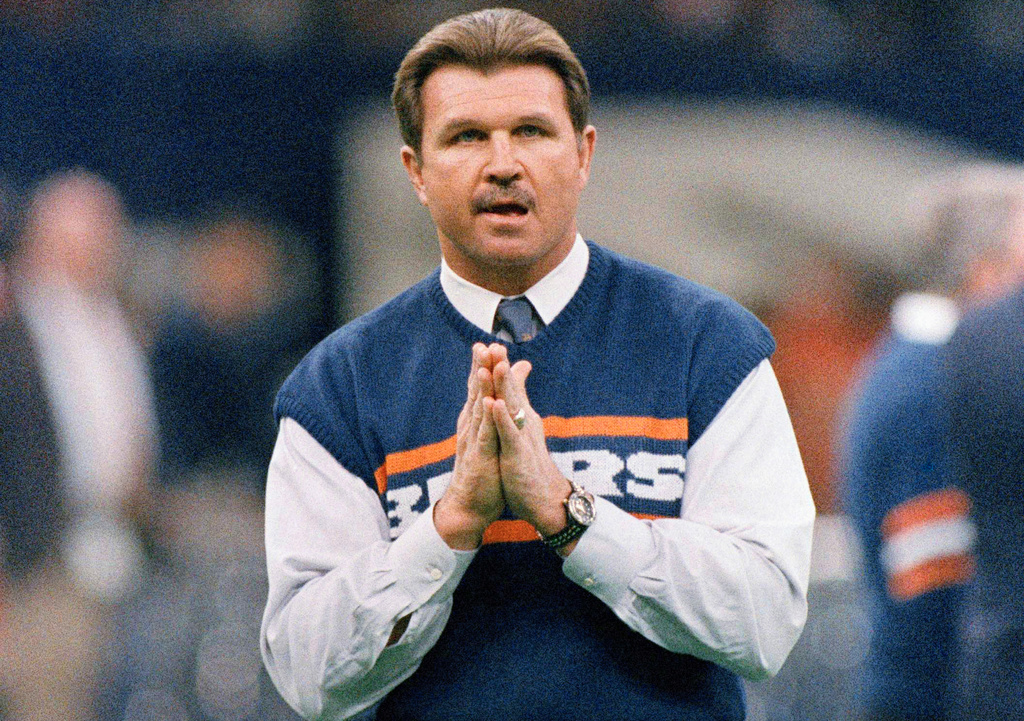
FILE - Chicago Bears head coach Mike Ditka strikes a prayerful pose as he watches the team workout, Jan. 26, 1986 in New Orleans before the start of NFL football's Super Bowl XX. (AP Photo/Rob Kozloff, File) Photo: Associated Press